Time and again
Description and Rules
.
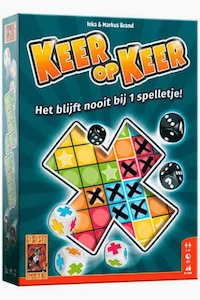
Players roll dice and use the outcome to color in squares of a certain color on their score sheet. By choosing which squares to fill in wisely, you can earn bonuses and check off more squares. The game revolves around good planning, thinking ahead, and making efficient use of the dice.
🎯 Objective of the game
The goal of Keer op Keer is to score as many points as possible by cleverly coloring in squares, completing rows, and collecting bonuses.
👥 Target audience
Keer op Keer is suitable for children, teenagers, and adults who enjoy puzzle-like dice games. The game is generally recommended for ages 8 and up.
👤 Number of players
Minimum: 1 player
Maximum: 6 players
Type of game
🍀 Luck:🔴🔴🔴⚪⚪ The dice determine which color and number of squares you can color in, so there is a bit of luck involved.
💣 Risk: 🔴🔴⚪⚪⚪ There is little direct risk; players mainly try to fill their squares as efficiently as possible.
🧠 Tactics: 🔴🔴🔴🔴⚪ It is important to plan wisely which squares you color in order to get bonuses and score as many points as possible.
📖 Rules of the game
PREPARATION
1. Each player receives a score sheet and a pencil.
2. Prepare the 6 dice.
3. Choose a starting player.
GAME PLAY
1. ROLL THE DICE The active player rolls all the dice.
2. CHOOSE A COMBINATION The active player chooses:
– 1 colored die
– the white die
Add the values of both dice together. This determines how many squares you can color in the area of the chosen color.
3. OTHER PLAYERS The other players may also choose a colored die. They only use the value of that die (without the white die).
4. REMOVING DICE The chosen colored dice are removed from the round. The remaining dice are then thrown again.
COLORING IN SQUARES
– The squares must be in the same color area.
– The squares must be adjacent.
– You may color fewer squares than the number you are allowed.
BONUSES
Some squares contain bonus icons such as:
– color extra squares
– extra points
– extra actions
Bonuses can cause chain reactions.
END OF THE GAME
The game ends when:
– a player has completely filled in two colors, or
– a player has crossed out 20 squares.
SCORING
Each color zone awards points depending on the number of squares colored in. Bonus points are added to this. Empty squares can result in negative points.
The player with the most points wins.
Official rules (Dutch)